Taking some fresh air with Edison at Heathlands Nature Reserve on 23/03/20.
Page 8 of 11
A walk with my son Edison in Willesborough Woods on 22/03/20 I talk about how society has changed in the last week.
I usually dont blog so often but things have moved so quickly recently. Last week life seemed normal whilst watching Champions League football at home on TV with a packed Anfield crowd now only eleven days later the British Prime Minister, Boris Johnson is using wartime language and the United States of America President Donald Trump has declared a state of emergency. Social media is awash that the United Kingdom may go into lockdown following many other countries around the world. Panic is high and likely to get worse. What is going on?
First I would like to state I wish to be positive but have many concerns. World financial collapse, martial law, the marginalisation of the elderly in future have all become more likely since 12th March; when Dr Tedros Adhanom Ghebryesus, Director-General of the World Health Organisation (WHO) declared a ‘pandemic’. This has set the world’s media alight as the ‘coronavirus’ become commonly known as ‘Covid-19’. This has resulted in panic buying and fights over toilet roll. A friend commented that a point was reached this week when it became rational to panic buy and stock up on food. Society’s reaction and perception to the problem has been immense fear.
I watched a Youtube video posted by Truthstream Media (link below) which comments:
“Repetition is the simplest form of brainwashing and all I hear is wash your hands, wash your hands, wash your hands. But, here is something else you need to know.
All of the things that start in your body start on a psychic level”.
At a time of great fear and panic, the crown (corona in Spanish) chakra shuts down and we lose our connection with life energy and divinity. Without this energy human beings tend to feel disconnected with others and our joie de vivre is likely to decrease. It will therefore be even more important to focus on our spiritual connection so we can find creative solutions to the challenges ahead. The video leads on to a poem to take inspiration from Frank Hubert – Dune.
“I must not fear.
Fear is the mind-killer.
Fear is the little death that brings total obliteration.
I will face my fear.
I will permit it to pass over me and through me.
And when it has gone past I will turn the inner eye to see its path.
Where the fear has gone there will be nothing.
Only I remain”.
I pray for a miracle that the world will overcome this panic and breakdown of society. Hopefully the warmer weathers of Spring will reduce the outbreak and some normality will be resumed. The world has been shook by this and the tremors will last for many years. Amidst so much fear, our ability to love and support each other will be tested more than ever by self isolation and social distancing. This is the beginning of a new world and without healing our inner fears, our external world may manifest as a future Hunger Games society. This crisis offers an opportunity for a great awakening, to find new, responsible ways to interact with our environment and with each other; may the odds be ever in our favour.
Link to video: www.youtube.com/watch?v=”RBi7HbNdWA
Walking with my son Edison through Mersham Deer Park on 19/03/20 I comment and speculate about current and future events.
This week the World Health Organisation (WHO) has declared the coronavirus (Covid-19) as a global pandemic. So far we have seen quarantines, self isolations, financial markets crash and supermarket shelves empty as people panic in reaction to the outbreak.
To date we have seen 6,492 number of deaths worldwide and these numbers continue to grow. In the last few few days we have seen France close all schools for the immediate future, the United States ban travel into the country from Europe and major sporting events and large congregations postponed across the world. This is an unprecedented scenario unlike anything the world has seen before.
So what happens next? As the virus spreads and more people die I expect borders to close and travel to be further restricted. I expect areas to be quarantined, curfews inflicted and civil liberties to be reduced as precautionary methods are taken to protect public health. Financial markets will also continue to fluctuate as global economies are affected by workplace closures and the overriding uncertainty caused by the virus.
I have read that scientists in Israel have developed a Coronavirus vaccine but a long period of pre-clinical and clinical trials is set to follow. I have also seen in the last few days that Bill Gates has resigned from his position on Microsoft’s board to concentrate on philanthropy and can see his Foundation potentially fund the global distribution of the vaccine. I suggest that the fear caused by the pandemic could lead to mandatory vaccinations in the name of public health and safety. Financially, the fiat money system may never be the same with paper notes and metal coins demonised because of their threat of spreading infection leading to a new crypto-based, cashless society.
My inner cynic questions the coincidences that ‘Event 201’, a scenario where a a novel zoonotic coronavirus outbreak was modelled by the World Economic Forum and the Bill and Melinda Gates Foundation in October 2019; also that Israel’s Galilee’s Research Institute group had the “pure luck” (as described by biotechnology group leader Dr. Chen Katz) to choose the coronavirus as their model for their system as a proof of concept for their technology. With the advanced nano technology that could permit a vaccine to be be a trojan horse for microchipping the world’s population it would be imprudent to not have concerns.
It remains unknown what will happen although it seems likely that the virus will continue to dominate headlines for the foreseeable future. Whether it is months or years the world we know when we reach the other side of this pandemic is likely to be very different. I suggest the impact this will have on the freedom of the world could be similar to 9/11.
Last year I came across the work of the Institute for Economics and Peace (IEP), an independent, not for profit research organisation dedicated to understanding the intersection between peace, prosperity and the economy. The organisation is behind the Global Peace Index, an instrument ranking 163 countries on their respective levels of peacefulness.
Based on my interest in the subject I learnt more about the IEP’s work through their online teaching and subsequently applied for their 2019 IEP Ambassador programme. This post will provide a summary of the key points of my learning.
Established in 2009 the IEP has offices in Australia, the United States, Mexico, Belgium, Zimbabwe and the Netherlands and one of it’s main goals is to create a shift in how the world thinks of peace, through using data driven research to show that peace is a tangible measure of human well-being and development. Society currently tends to think of progress in terms of economic growth, typically reflected by Gross Domestic Product (GDP) but there is an increasing recognition of the need to view societal development, including measures of well-being and peace as benchmarks of progress. Although not related the idea reminds me of the country Bhutan who do not measure GDP but instead Gross National Happiness.
Yet whilst the IEP recognises the emergence of these new needs it does not neglect the importance of the economic and financial benefits of reductions in violence and improvements in peacefulness because that is a key way to motivate government, business, and the public. Promoting the economic benefits of peace is significant as without it, peace could be dismissed as a nice to have; although with economic benefit peace becomes a win win.
The basis of this work comes from the father of peace studies Johan Galtung who defined the concepts of peace used in the IEP’s research: negative and positive peace. Negative peace is the ‘absence of violence’ or ‘absence of fear of violence’ such as when a ceasefire is signed. Positive peace is is the attitudes, institutions and structures that create and sustain peaceful societies. Examples of this are well functioning governments, equitable distribution of resources, free flow of information, good relations with neighbours, high levels of human capital, acceptance of the rights of others, low levels of corruption and a sound business environment. When levels are high in these areas an optimum environment is created for peace to flourish.
These areas are some of the 23 qualititaive and quantitative indicators used by the Global Peace Index to rank 163 countries on their respective levels of peacefulness. The indicators fall into three general categories: societal safety, ongoing domestic and international conflict and militarization and are weighed on a 1-5 scale.
The detail which goes into the Global Peace Index is very detailed and produces a plethora of data for analysis. It is not my intention to go into vast detail within this post as interested parties can access the full report online but I will outline the top-level highlights from 2019:
– For the first time in five years the average level of country peacefulness has improved (by 0.09% from the previous year), with 86 countries becoming more peaceful and 76 deteriorating.
– Iceland remains the most peaceful country and Afghanistan has replaced Syria as the least peaceful.
– Ukraine, Sudan, Egypt, North Macedonia and Rwanda are the countries which showed the greatest improvement in measures of peacefulness.
– Nicaragua, Birkina Faso, Zimbabwe, Iran and Brazil showed the largest deteriorations.
Furthermore over the past decade the following trends have been identified:
– Since 2008 the average level of peacefulness has declined by 3.78%.
– Over the course of the decade, 81 countries deteriorated in peacefulness, while 81 improved.
– Deaths from conflict rose by 140% since 2008 however since 2014 conflict related deaths have fallen by 26.5%.
– 63% of countries recorded increased levels of terrorist activity.
– The Militarization domain recorded a 2.6% improvement in peacefulness.
– A continuing trend indicates a growing gap between the least and most peaceful countries.
Further to the ranking of countries’ respective levels of peacefulness, one of the most notable results from the Global Peace Index 2019 is the economic data:
– The global impact of violence in 2018 was $14.1 trillion, equivalent to 11.2% of overall global GDP.
– In the last 70 years, per capita GDP growth has been nearly three times higher in highly peaceful countries compared to those with low levels of peace.
Overall the strong link between positive peace and economic prosperity highlights both the social and economic benefits of peace. Unfortunately the decline in peacefulness and rise in terrorism within the last decade indicates that the world has not yet been able to apply these lessons. There is also an alarming inequality between countries with high and low levels of peace which is growing. Being able to understand the factors which contribute towards peace and the costs involved is an exciting area of work which should encourage the world to shift it’s resources and strategies from containing violence towards the factors that promote peace. The IEP calculate that “if the world decreased violence by 10%, $1.48 trillion could be directed to other economic activities” – there is incredible scope to solve many of the world’s problems with the savings of a more peaceful world.
The IEP Ambassador programme has been an interesting experience and I look forward to following the findings of the Global Peace Index and sharing my learning further in future years.
More information about the Institute for Economics & Peace can be found on their website: visionofhumanity.org.
‘Mental Health’ is a term increasingly seen and used in all areas of life. In the last week I have seen and read numerous articles on Youtube, in books, online and at work increasing knowledge on the subject. The aim is to remove the stigma so people feel more able to share their feelings and subsequently gain the support that everyone may need at different points of their lives.
Due to his fight with Deontay Wilder this week there has been a lot of attention given to Boxing Champion Tyson Fury who previously has sufferred from depression and spoken openly about his mental health. One of the most striking comments I recall is that if someone such as Fury, a high profile sportsman within a macho sport can be affected then anyone can; and it is okay to not feel 100% all of the time.
This leads to why I have written this post because recently I haven’t been feeling at my best. This has led to feelings of anxiety and frustration which inevitably has impacted on my interpersonal relationships. There are reasons I can attribute this to, a lack of sleep, suffering from a cold and a series of deadlines and events requiring my presence and attention. Due to this overall state of busy-ness I have not given sufficient time to relax, meditate or indulge in methods of self care such as eating healthy food, exercising or taking a relaxing bath. Furthermore I have not given sufficient time for my friends and family.
Fortunately I have a day coming up which I plan to use to recover and I know the steps I intend to take to get back on the right track to optimal mental health. Catching up on sleep, getting tasks done, exercising, relaxing, goal setting and scheduling time for these exercises will hopefully improve my outlook and confidence to conquer life’s challenges. This coupled with the longer, brighter and warmer days of Spring should bring positive changes.
Overall, I feel confident that my negative feelings are temporary and am fortunate there are people around me that will help give me the boost I need. In the future I’m sure there will be times when I feel at a low ebb and similarly these people may require my support in return. A problem shared is a problem halved and by writing this I already feel more confident and able to return to my best. I hope that anyone reading this will also feel more empowered to speak out about any problems they may be suffering from; life is so fast it’s normal to need a helping hand from time to time.
So today at 11pm the United Kingdom will leave the European Union. A historic day which has been marked with mixed celebrations across the country and the minting of a new 50 pence piece. But what does it mean in reality?
In essence, very little will change in the coming months as the UK moves through its transition period to December 2020. No longer will the UK have voting rights in the Council or have MPs sitting in the European Parliament but the major issues of the free movement of people and goods will continue undisturbed until a withdrawal agreement is agreed.
I had written previously that I would be surprised if by January 31st 2020 a true Brexit had taken place and much work is still required. I argue that so far all this step has really achieved is the partial appeasement of the conflictive and emotional situation which has divided the British public since the referendum of 2016. Due to a Conservative majority in Parliament Boris Johnson will be confident that he can push through Brexit to completion but some important issues still need to be agreed and it remains unknown whether significant changes regarding immigration or trade will take place.
Thus, eleven more months of political debate and negotiation is on the horizon and despite today’s billing as the day the United Kingdom leaves the European Union, ‘Brexit Day’ is just another chapter in this long running saga.
The transition from 2019 to 2020 has been a time to reflect on where I am in my life. Receiving news that I had been successful in my application for promotion a few days prior to Christmas enhanced some truly brilliant, lovely family moments over the festive period.
My son, Edison is 22 months old and watching his progress and development has been a joy; I love him and my family so much.
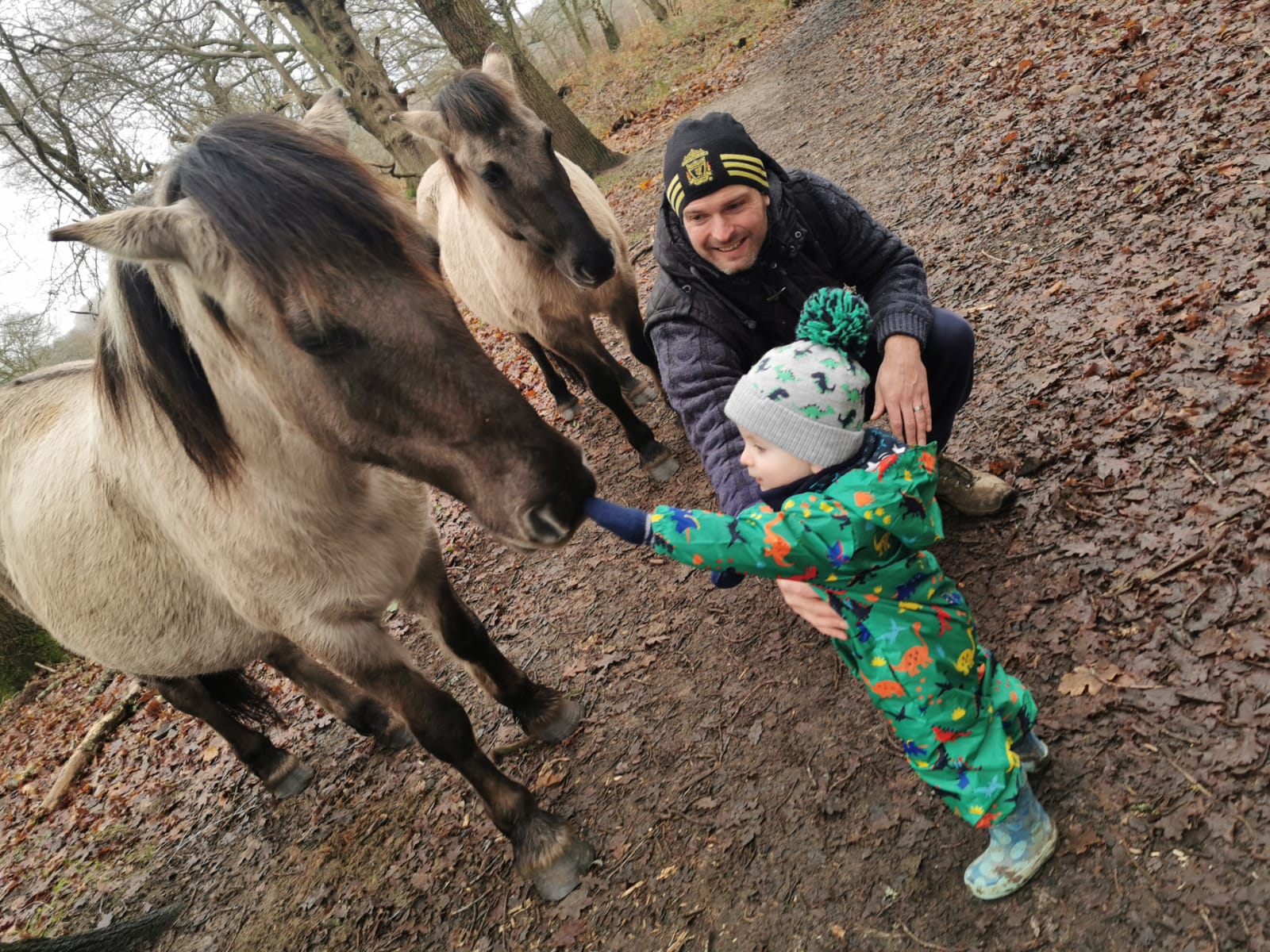 With my son Edison at Heathlands Nature Reserve, December 2019.
There are many goals and projects forming and hope I will retain the energy to develop these. I know that at my best I have great determination but when I am tired or have fear I can lose my connection with what is real (only love is real) and lose focus. I hope this year to remember Marianne Williamson’s quote from her book ‘A Return To Love’:
“Our deepest fear is not that we are inadequate. Our deepest fear is that we are powerful beyond measure. It is our light, not our darkness that most frightens us. We ask ourselves, ‘Who am I to be brilliant, gorgeous, talented, fabulous?’ Actually, who are you not to be? You are a child of God. Your playing small does not serve the world. There is nothing enlightened about shrinking so that other people won’t feel insecure around you. We are all meant to shine, as children do. We were born to make manifest the glory of God that is within us. It’s not just in some of us; it’s in everyone. And as we let our own light shine, we unconsciously give other people permission to do the same. As we are liberated from our own fear, our presence automatically liberates others”.
The title of this piece is is urban fighting talk as I want to be bold and conquer all adversities. Conversely I know that to achieve this I must surrender to the present moment. I must trust in myself and the magnificence of the universe.
May 2020 be the best year ever.
Recent Comments